This page answers the questions people actually type about the Crazy Crawler, roughly in the order they ask them: what it is, how old it is, what decides its value, and what to do with it.
What exactly is a Crazy Crawler?
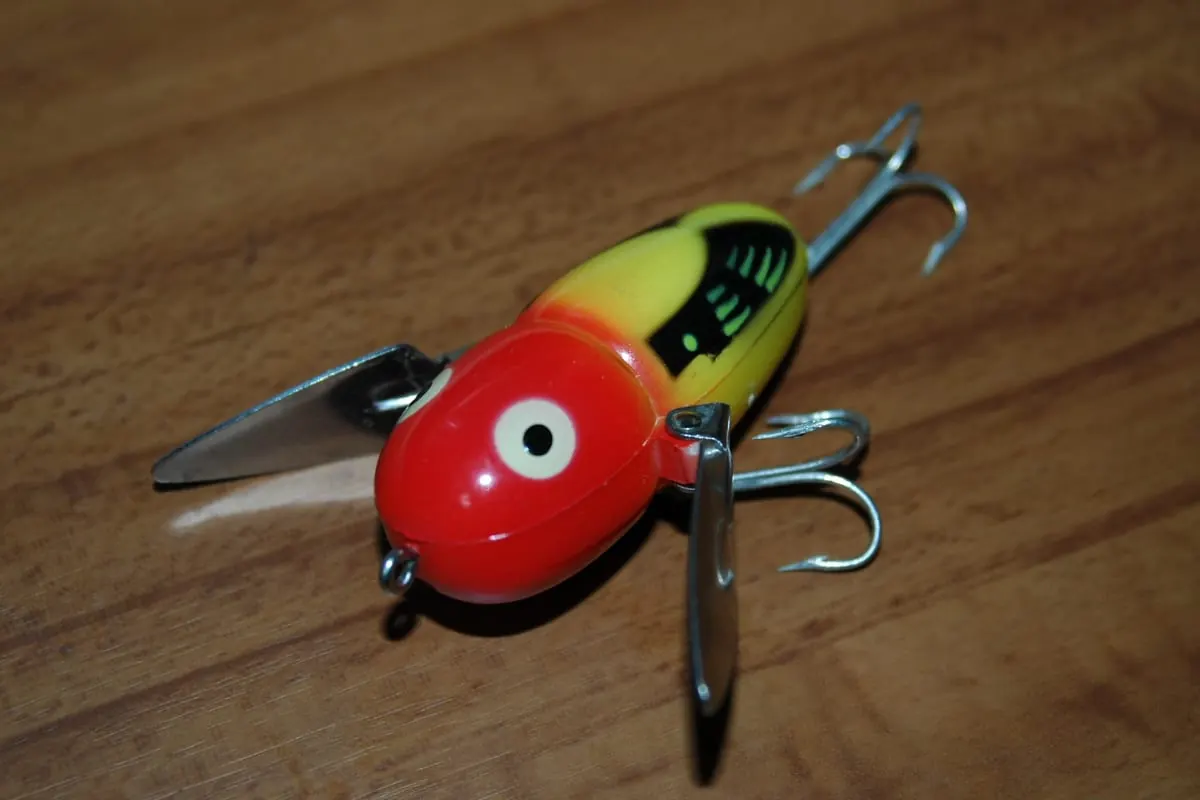
A Heddon topwater lure with two metal wings hinged on the sides of a short, fat body. On the cast the wings fold back against the body. As soon as you start reeling they open, catch water and make the lure waddle side to side with a loud plopping crawl. It's built for bass at night and in calm water, where the noise draws fish from a distance.
The Dowagiac Area History Museum, which holds a large Heddon collection, records it as introduced new in 1940 and shows a wooden example from the 1940s. That's two years after Arbogast's Jitterbug, the lure it's most often confused with. The Crazy Crawler is still sold in plastic today, which tells you most of what you need to know about value: there are a lot of them.
How do I know if mine is old?
Work through these in order. Each one narrows the window.
- Wood or plastic. The first Crazy Crawlers were wooden. A visible mold seam along the body means plastic. Grain under chipped paint means wood.
- Eyes. Stick-on 3D eyes or eyes molded into the plastic point to recent production.
- Wing hardware. Look at how the wings attach and whether they carry any stamping. Compare against a new Crazy Crawler from a store. Different hardware deserves a closer look.
- Hook hardware. Heddon's hook hangers changed over the decades, and the sequence is how collectors date Heddon lures. Lure Lore has clear photos of the main types on Heddon plastics.
- Box or card. Packaging style dates a lure more precisely than the lure itself, if you still have it.
One caution: an old-looking wooden lure isn't always old. Real age shows as even, honest wear: paint worn where hooks rubbed, hardware that has darkened along with the body, no fresh paint over rust. The general version of these checks, for any maker, is in our guide to identifying old fishing lures.
Why are there so many plastic ones?
Because it worked, and anglers kept buying it. A lure that stays in production for more than 80 years gets made in enormous numbers, and each generation of anglers leaves a few in tackle boxes for the next. That's good for fishing and bad for resale: the supply of plastic Crazy Crawlers will always outrun the number of collectors who want one. Rarity on this model lives in the wooden bodies, the uncommon colors and the boxes.
So what decides its value?
We don't publish price ranges. Sold prices for Crazy Crawlers swing widely with the details below, and a range would hide exactly what matters. These are the factors, roughly from most to least important:
| Factor | Helps | Hurts |
|---|---|---|
| Body | Wood | Plastic, especially recent |
| Wings | Original, straight, fold and open freely | Bent, stuck, missing or replaced |
| Paint | Original, bright, light wear | Repaint, heavy loss at head and nose |
| Color | Uncommon factory colors | The common colors made in volume |
| Hooks | Original to the lure | Replaced with modern hooks |
| Packaging | Original box with matching label | No box, or a box from another lure |
To get a number, search eBay with the Sold Items filter on, using "Heddon Crazy Crawler" plus wood or plastic and the color. Keep only examples in similar condition, and use three to five matches. Asking prices for Crazy Crawlers run well above what buyers pay, so ignore active listings.
Is it a Crazy Crawler or a Jitterbug?
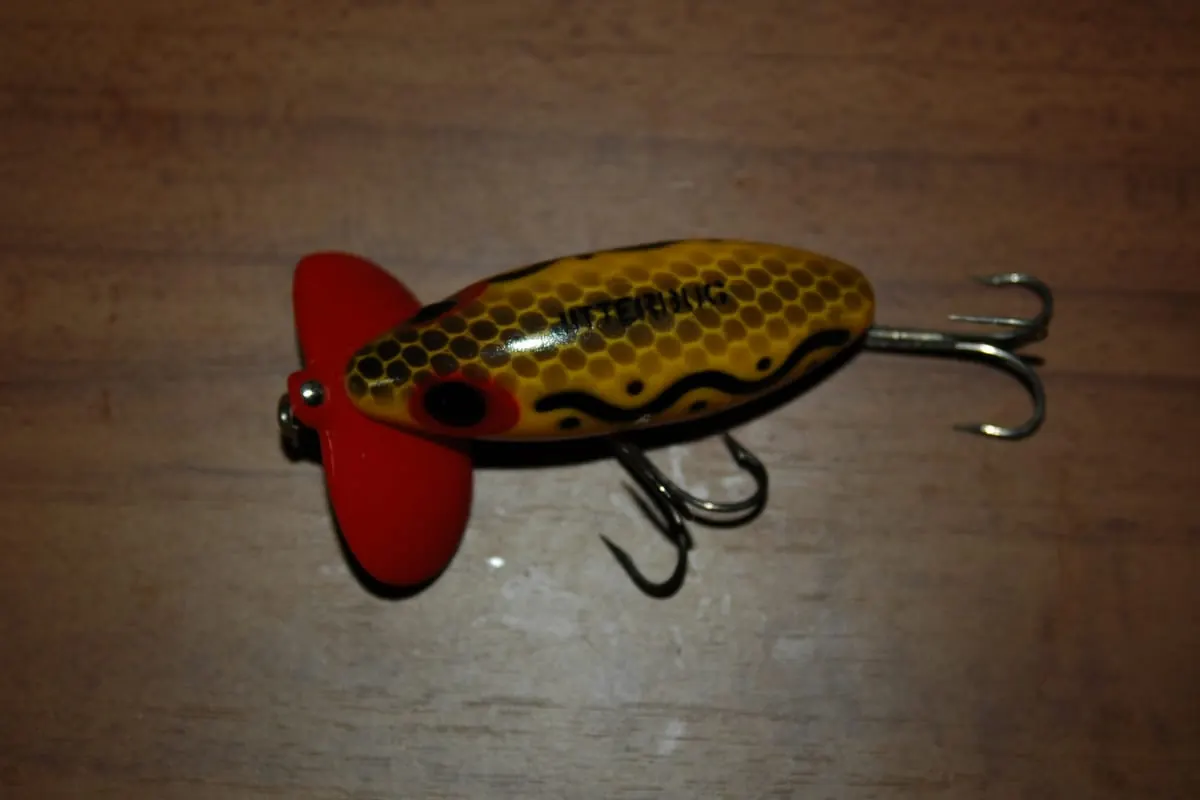
The two are confused constantly, in tackle boxes and in eBay titles. The difference is the front of the lure.
| Crazy Crawler | Jitterbug | |
|---|---|---|
| Maker | Heddon, Dowagiac, Michigan | Arbogast, Akron, Ohio |
| What makes the action | Two hinged metal wings on the sides | One wide metal lip across the face |
| Introduced | 1940 (Dowagiac Area History Museum) | 1938 (USLures company history) |
| Key collector variant | Wooden body | Wartime plastic lip |
If yours turns out to be a Jitterbug, our Jitterbug lure guide covers dating and pricing for that one.
What condition problems cost
The wings make the Crazy Crawler more fragile than most topwaters. These are the problems buyers look for, and how seriously they take each one on an older example.
| Problem | How buyers treat it |
|---|---|
| Wings that won't fold or open | A real flaw; ask before buying |
| Bent wing, still attached | A flaw, but the lure is complete |
| Missing or replaced wing | A serious flaw on any collectible example |
| Rust stains around the wing hardware | Expected on old lures unless severe |
| Paint worn off the head and nose | Normal on a fished lure, lowers the grade |
| Cracked wooden body | A serious flaw |
| Repaint | Collectors treat it as a decoration |
Rust stains deserve a note. Iron hardware leaves orange halos in the paint around it, and on old Crazy Crawlers those stains are very common. Collectors accept light staining as part of the lure's age. Trying to scrub it out takes the paint with it. If you want to know what's safe, read up before you try anything.
How to photograph one for a buyer
- Side view with the wings open, in daylight.
- Top view showing both wings and the paint on the back.
- Belly, showing the hook hardware.
- Close-ups of each wing where it attaches to the body.
- Any chip that shows whether the body is wood or plastic.
Most questions a buyer asks about a Crazy Crawler are about the wings, so show them clearly and say whether they move freely.
Can I still fish it?
A plastic one, absolutely. Cast it near cover, let it sit, then reel slowly and steadily. Too fast and the wings skate instead of paddling. Night fishing is where it shines: bass find it by sound. Wait to feel the fish before setting the hook, because the splash comes before the bite.
A wooden one, no. Wings bend, paint chips on the first rock, and a missed hook set into a dock post can ruin a collectible. Buy a new Crazy Crawler for fishing and keep the wooden one dry.
Buying one to collect
If you're on the other side of the sale, the risks are predictable. Before paying for wood, ask for or check:
- A photo of a paint chip or worn spot that shows the body material.
- Clear shots of both wing attachments. Re-attached or swapped wings are hard to see in a wide photo.
- The belly hardware, compared against documented examples.
- Whether the hooks are original. Ask directly.
- For boxed lures, whether the box label matches the lure inside.
What should I do with a box of them?
- Sort wood from plastic. That's the main value split.
- Don't straighten, clean or repaint the wooden ones. Collectors pay for original, and a careless fix shows.
- Keep boxes with their lures. A box with its matching lure beats either one alone.
- Sell plastic ones in lots, wooden ones alone. Lots are fine for common lures and bad for the good ones.
For the rest of the brand, see the Heddon guide. If the same box has other Heddon topwaters, the Heddon Torpedo and Zara Spook guides cover two of the most common.