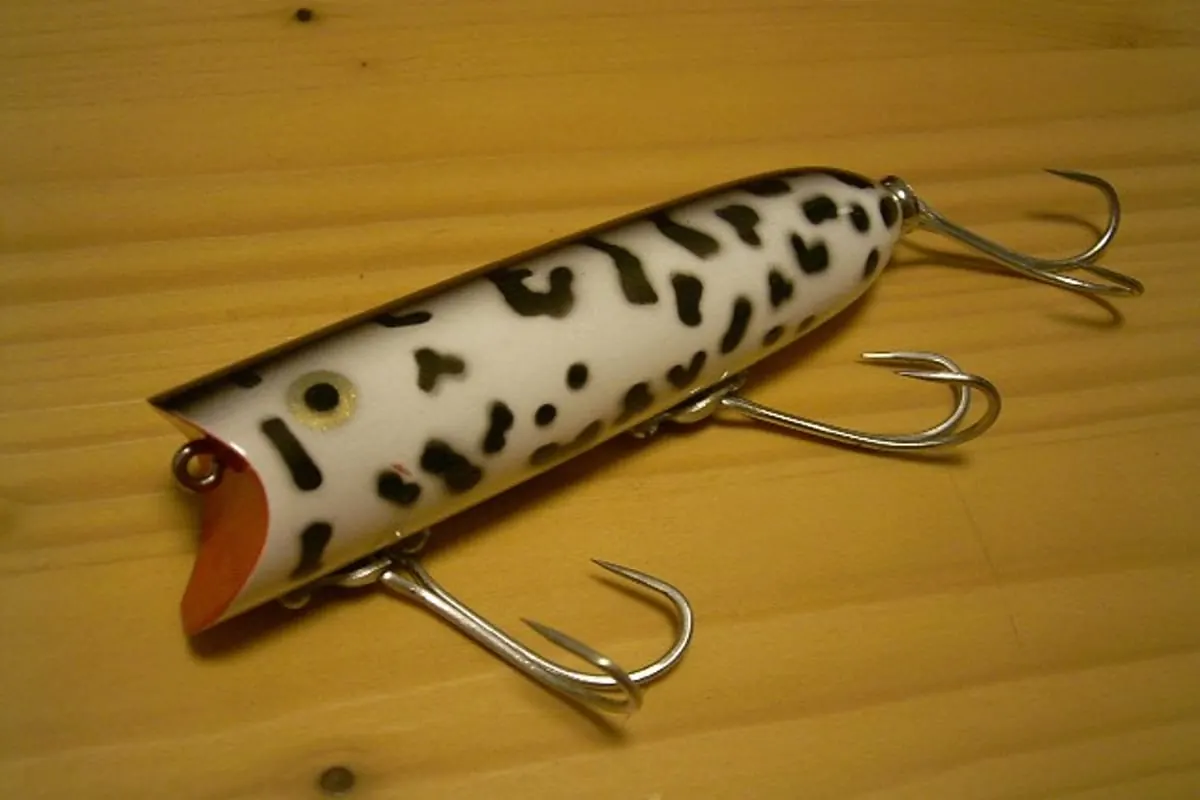
Whether you're about to sell one or about to buy one, the same nine questions decide what a Lucky 13 is worth. Answer them in order. If you're stopping at question two with "recent plastic," you have a common fishing lure and can skip to the fishing section at the end.
Where the facts come from
The most detailed public history of this model is oldfishinglure.com's Lucky 13 page. It says the lure grew out of Heddon's Wiggle King in the late 1910s and was first cataloged in 1920, lists the regular model as series 2500 at about 3 7/8 inches and the junior as series 2400, and lays out the hardware sequence used below. Heddon itself was founded in 1902 in Dowagiac, Michigan, and introduced its first plastic lures in 1932, according to Carl F. Luckey's collector reference as cited on Wikipedia.
The nine-question checklist
| # | Question | Answer that adds value |
|---|---|---|
| 1 | Is it really a Lucky 13? | Scooped mouth, hump-backed body, Heddon hardware |
| 2 | Wood or plastic? | Wood |
| 3 | What hook hardware? | Early types: cup rig, L-rig, toilet seat |
| 4 | What eyes? | Consistent with the hardware generation |
| 5 | Original paint? | Yes, even with wear |
| 6 | What color? | An uncommon catalog finish |
| 7 | Original hooks? | Yes |
| 8 | Regular or junior? | Both collected; size matters less than age |
| 9 | Box? | Original box, matching model and color |
Working through it
1. Confirm the model
The Lucky 13 has a hollowed, scooped face that slopes down into the chin, and a body that's fatter at the front than the tail. Plenty of makers built similar chuggers, so look for Heddon hardware and markings. A plain scoop-faced plug with no marks and cheap screw eyes is more likely a lookalike.
2. Wood or plastic
This is the biggest single split in value. Look for grain under chipped paint (wood) or a thin seam running along the body (plastic). Our guide to antique wooden fishing lures has five non-destructive tests if you're unsure.
3 and 4. Hardware and eyes
These date a Lucky 13 more precisely than anything else. The oldfishinglure.com page gives this order, earliest first:
| Stage | Hardware | Notes from the source |
|---|---|---|
| 1 | Cup rig | The earliest, including no-eye, long-lip variants |
| 2 | L-rig | Regular and heavy-duty versions |
| 3 | Toilet seat rig | Named for its shape |
| 4 | Two-piece flap rig | A plate with a separate hinged hanger |
| 5 | Surface rig | Paired with tack eyes |
| 6 | Plastic body | Painted eyes |
If you can't picture the rigs, Lure Lore has photos of the flap rig and surface rig on Heddon plastics, and our identification guide explains hardware in general. When eyes and hardware disagree, for example tack eyes on a cup rig, suspect swapped parts or a repaint.
5 and 6. Paint and color
Original paint with honest wear beats a fresh repaint every time. Check for paint over rust, overspray on hardware and a gloss that's too new. Color is the multiplier: common finishes made in volume are the baseline, and colors cataloged only briefly are what collectors hunt for. Because color names changed over time, compare your lure against sold listings with photos rather than trusting a name alone.
7 and 8. Hooks and size
Replaced hooks lower the value of a wooden lure. Bright new hooks on split rings on a wooden body usually mean someone fished it after the originals rusted. Size matters less: regular and junior versions are both collected.
9. The box
An original Heddon box with the right model number and color code can be worth as much as the lure. Keep them together, and don't tape a torn box.
Why the Lucky 13 is common, and why that's useful
A lure that has been made since 1920 exists in huge numbers, so most Lucky 13s are common. The upside is that the model is well documented and plenty of examples have sold, which makes it one of the easier Heddon lures to price accurately.
How to price yours
We don't publish price ranges. A Lucky 13's price comes from the combination of answers above, and only completed sales capture that.
- Write down the answers to the checklist: material, hardware stage, eyes, color, size, box.
- Search eBay for "Heddon Lucky 13" plus wood or plastic and the hardware, with the Sold Items filter on.
- Keep only sold examples that match on hardware stage and condition. A cup rig lure and a surface rig lure are different items.
- Find sold examples with and without a box to see what the box adds.
- Use three to five matches, not one.
The Heddon guide covers the rest of the brand, and old fishing lures worth money covers the lures that sit far above a Lucky 13.
Lucky 13 or another chugger?
Scoop-faced surface lures were made by many companies, and a worn one with no markings can pass for a Lucky 13 at a glance. The main ones it gets confused with:
| Lure | How it differs from a Lucky 13 |
|---|---|
| Arbogast Hula Popper | Skirt at the tail, deeper cupped mouth |
| Generic hardware-store poppers | No markings, cheap screw-eye hardware, simpler paint |
| Recent Heddon Lucky 13s | Correct shape, but modern hooks, finish and packaging |
The Lucky 13's body shape is the giveaway: deeper and humped near the head, tapering toward the tail, with the scoop cut down into the chin rather than straight across the face. Lookalikes are usually straighter and more cylindrical.
What buyers look at first
If you're selling, photograph these, in this order, because they decide whether a collector clicks:
- A side view in daylight showing the full paint pattern.
- A close-up of the eye.
- A close-up of the hook hardware on the belly.
- Any chip that shows the body material.
- The box, every side, if you have it.
Say plainly what you don't know. "Wood, L-rig, hooks may be replaced" sells better than a confident wrong date.
Buying one online
The Lucky 13 is a popular starter lure for new Heddon collectors, which also makes it a common place to overpay. A few rules:
- Ask how the seller knows it's wood. A photo of a chip settles it.
- Check the hardware against the stage table. Mixed hardware styles on one lure suggest parts have been swapped.
- Compare the paint wear to the hardware wear. Shiny paint on rusty hardware is the classic repaint pattern.
- Treat "rare" in a title as a claim. Most Lucky 13s aren't.
- Pay for the lure in front of you, not the best example you've seen sold. Condition is most of the price.
Fishing a Lucky 13
A new plastic Lucky 13 is a good, cheap bass lure. Jerk the rod tip and the scooped face throws a splash and a pop, like a popper. Reel steadily instead and it ducks under and swims with a wide wobble just below the surface. Mixing the two, a couple of pops then a short swim, is how most people fish it. Keep wooden ones out of the water: one snag can ruin a collectible.
For other Heddon topwaters likely to be in the same box, see the Zara Spook, Torpedo and Crazy Crawler guides.