Three questions cover almost everything people want to know about a Flatfish: what size is it, who made it, and how do you get it to swim. This guide answers them in that order, then shows how to price one from real sales instead of guesses.
Where the Flatfish comes from
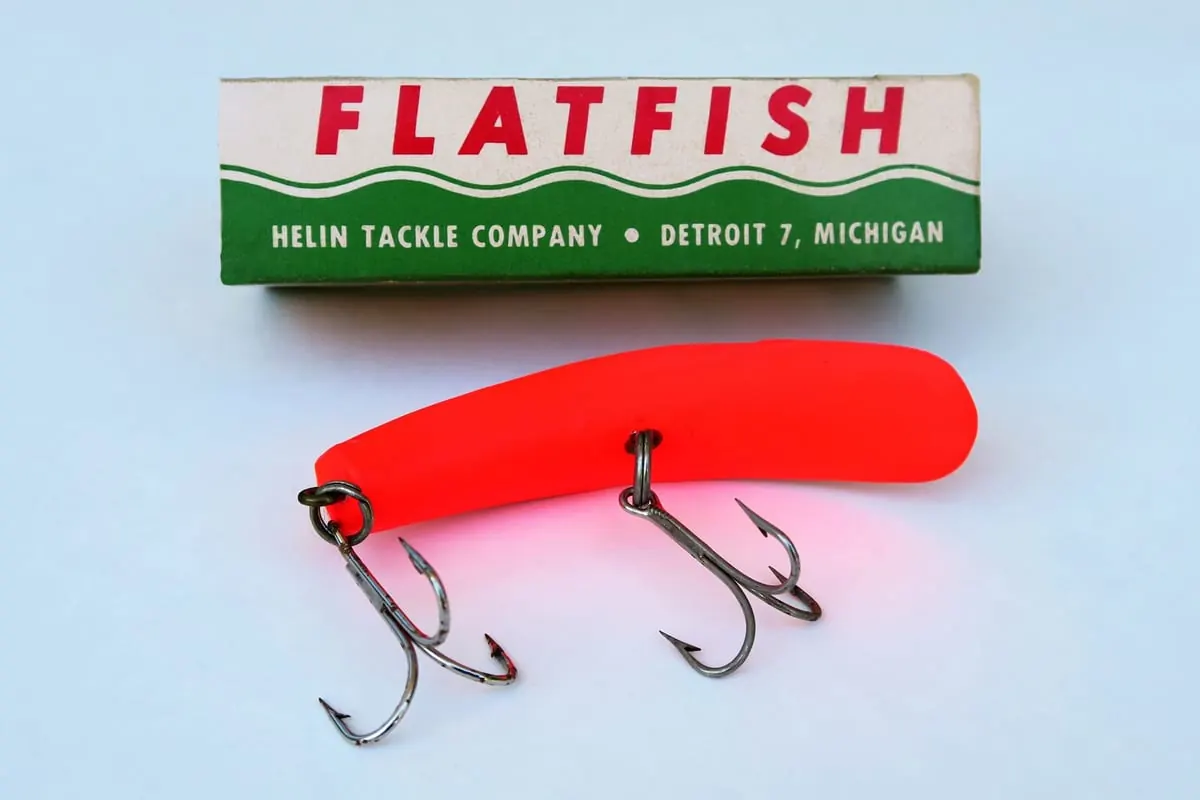
The photo at the top of this page, from Wikimedia Commons, shows a Flatfish next to its original box, printed "Helin Tackle Company, Detroit 7, Michigan." The file's description identifies Charles Helin (1905 to 1979) as the developer of the Flatfish and the founder of the Helin Tackle Company in Detroit.
The lure is still made. The current maker, Yakima Bait, credits the design to Charlie Helin and describes the Flatfish as a slow trolling, shallow diving plug with a wide wiggle. USLures, which catalogs vintage lures, lists Flatfish under Helin Tackle in many sizes, alongside a Flatfish sold under the Worden's Lures name and other Helin products such as the Kwikfish and the Fishcake. For the collector, the practical split is Helin era versus later production.
How to recognize one
Nothing else looks quite like a Flatfish, but worn examples and imitations do turn up. Check these:
- Curved, banana-shaped body. The body bends along its length rather than running straight like a minnow.
- No separate diving lip. The shaped front of the body does the work that a lip does on a crankbait.
- Hooks hanging from the belly. Trebles hang below the body, as in the photo above, rather than from a nose and tail.
- A size code. Genuine Flatfish are sold by letter and number codes, covered next.
- Maker's name. Look for Helin on older lures and boxes, or the current maker's branding on recent ones.
Reading the size code
Flatfish are identified by codes rather than by length in inches. Codes that appear in vintage listings on USLures include F2, F4, F5, F6, X4, X5 and M2.
| Where to find the code | What to do with it |
|---|---|
| Printed or molded on the lure body | Read it under a strong light; worn codes often show at an angle |
| On the end or side of the box | Check that it matches the lure inside |
| On the card or insert | Keep it with the lure; it helps buyers trust the match |
| Nowhere visible | Compare body length and hook size against coded examples |
Don't convert codes to inches from memory or from a forum post. The reliable reference is the current maker's chart for new lures and coded, photographed examples for old ones. When you list a Flatfish, put the code in the title. Buyers search for "Flatfish X5", not "orange banana lure".
Helin era or later?
Because the Flatfish never went out of production, dating one comes down to packaging and details rather than material.
| Clue | Points to Helin era | Points to later production |
|---|---|---|
| Box | Helin Tackle Company, Detroit address | Later maker branding |
| Body marking | Helin name | Current branding or none |
| Hooks | Dull, older style, matching wear | Bright modern hooks |
| Finish | Older paint with age wear | Modern colors and finishes |
The box does most of the work. A Helin box with the Detroit address, with the matching code and a lure that fits it, is the strongest evidence you'll get. Loose Flatfish are harder to place; compare them with dated, boxed examples in sold listings.
How to fish it
Yakima Bait's description is the whole instruction manual in four words: slow trolling, shallow diving. The Flatfish swims with a wide, side to side wiggle at low speed and loses that action if you pull it too fast.
- Tie it so the nose can swing freely. A loop knot or a small snap helps.
- Before letting out line, drop it next to the boat at your trolling speed and watch it. You want a wide, steady wiggle, not a spin.
- If it rolls or spins, slow down. Speed is the most common reason a Flatfish doesn't work.
- For deeper fish, add weight ahead of the lure rather than speeding up.
- From shore or a drifting boat, a slow, steady retrieve in current lets the water work the lure for you.
Match the size code to the fish and the water. Smaller codes for small water and lighter tackle, bigger ones when you're targeting larger fish. If you have an old Helin in its box, fish a new one: the box is worth keeping intact.
Lookalikes
The curved, lipless shape has been imitated, and Helin itself sold other lures such as the Kwikfish. If yours has no code and no maker's name, compare it against coded, photographed Flatfish before you list it under that name. A wrong name sends buyers and your pricing to the wrong listings.
How to price one
We don't publish price ranges. Flatfish were made in huge numbers in many codes and colors, so a single range would mean nothing. Use completed sales:
- Search eBay for "Helin Flatfish" plus the code and color, with the Sold Items filter on.
- Keep only results that match on code, packaging and condition.
- Compare boxed and unboxed sales. On a lure this common, the box is often most of the difference.
- Use three to five matches, not one.
| Factor | Helps | Hurts |
|---|---|---|
| Packaging | Helin box with matching code | No box |
| Condition | Unfished, bright finish | Chewed, scratched, faded |
| Hooks | Original | Replaced |
| Color | Uncommon colors | Common colors made in volume |
| Quantity | Boxed sets, dealer stock | Loose singles in a mixed lot |
Unopened dealer stock and full boxes of one code sometimes turn up from old tackle shops. Those sell better as a unit than broken up.
Buying a used Flatfish to fish
Old Flatfish are easy to find in tackle box lots, and many still fish well. Before you tie one on, check:
- The body. Cracks or splits along the curve change how it swims. Hold it up to the light and look along its length.
- The line tie. It should be straight and firmly anchored. A bent tie makes the lure run off to one side.
- The hooks. Rusty or bent trebles cost you fish. Replace them on a fishing lure, but keep the originals on anything boxed or collectible.
- The code. Make sure the size suits your target fish and tackle before you buy a dozen of one code.
Photographing one for sale
- A side view in daylight showing the full curve and finish.
- A close-up of the size code.
- The box, every side, including the maker's name and address.
- The hooks and hardware from below.
- Any cracks, chips or tooth marks, shown honestly.
A clear photo of the code and the box answers most buyer questions before they're asked.
Care and storage
Wipe a Flatfish with a barely damp cloth and dry it. Don't soak it, and keep it away from old soft plastic worms, which can fuse to finishes and eat into paint. The identification guide covers the details, including how to handle a box without damaging it.
For the other families of lures likely to share a tackle box with your Flatfish, see fishing lure types explained, and for wooden plugs from the same era, our antique wooden fishing lures guide.