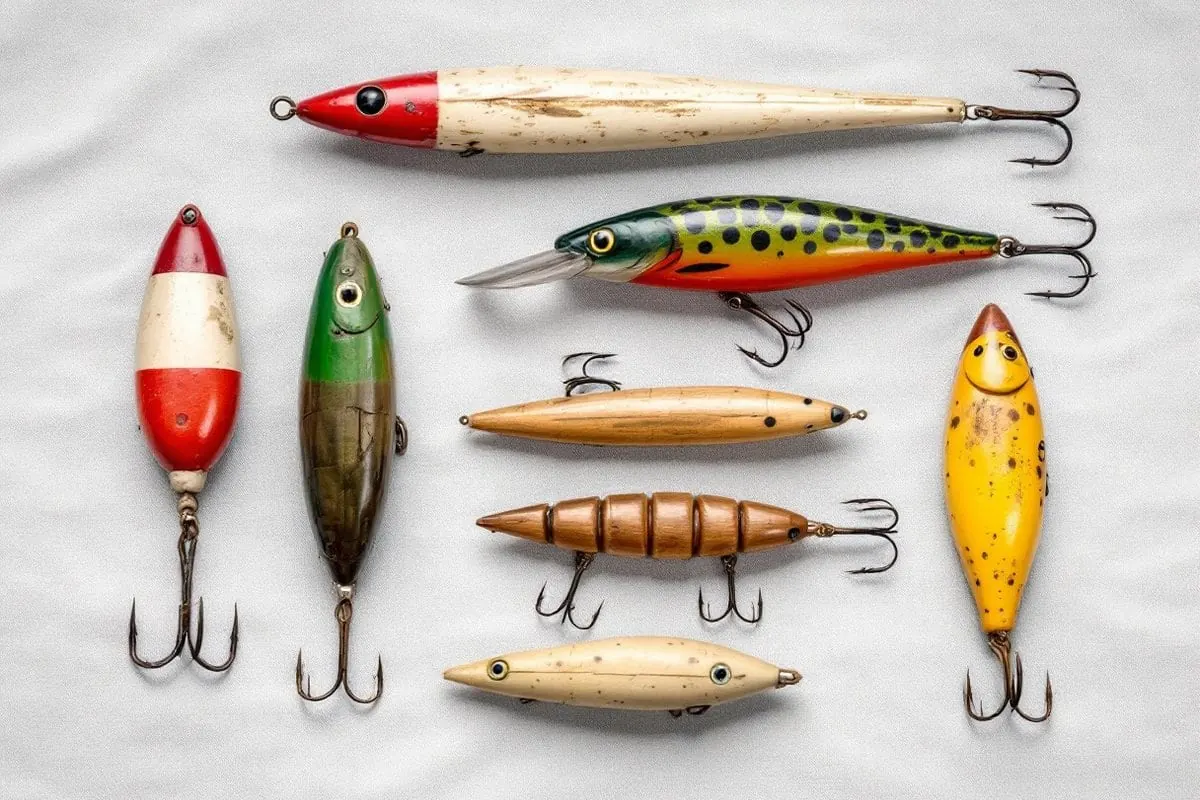
Before you think about maker or value, settle one question: is it actually wood? People get this wrong in both directions, listing plastic as wood and dumping wood into a cheap lot. Five tests settle it without damaging anything.
Five tests for wood
1. The chip test
Find any spot where paint has flaked: the nose, belly, around the hook hangers. Wood shows grain or a fibrous, pale surface. Plastic is smooth and usually the same color as the body all the way through.
Verdict: The most reliable single test. If you can see grain, you're done.
2. The seam test
Hold the lure under a bright light and look along the back and belly. Molded plastic lures are made in two halves and show a fine line where they met, running nose to tail.
Verdict: A clear seam means plastic. No seam leans wood, but heavy paint can hide one.
3. The heft test
Wood is lighter than you expect for its size, unless the maker added lead ballast. Hollow plastic can be light too, but solid plastic feels dense.
Verdict: Useful as a tiebreaker, not on its own.
4. The tap test
Tap the body lightly against a fingernail or a tooth. Wood gives a soft, dull knock. Plastic gives a sharper, higher click.
Verdict: Works well once you've done it on a lure you know is wood.
5. The hardware test
Look at how the hooks and line tie attach. Screws or screw eyes going straight into the body, cups held by tiny screws, and plates fastened on with screws all suggest a wooden body.
Verdict: Strong supporting evidence, and it also helps date the lure.
Two or more tests pointing the same way is enough. If they disagree, the chip test wins.
Why wood is where the value is
The classic American makers started in wood and moved to plastic at different times. A few dated examples, each from a source you can check:
| Maker | Wood to plastic | Source |
|---|---|---|
| Heddon | First plastic lures (the Spooks) in 1932; wooden models like the Zaragossa stayed in the catalog until 1952 | Luckey, via Wikipedia |
| Creek Chub | Lures traditionally carved from wood; experiments with plastic in the 1950s and 1960s | Wikipedia |
| Arbogast (Jitterbug) | Wooden Jitterbug first, plastic version in 1941 | Lurenet |
| Bomber | White cedar lures from the 1940s; all plastic from 1971 | USLures |
Collectors focus on the wooden era because it's older, survives in smaller numbers, and the paint work was more individual. The same Wikipedia article says Creek Chub's hand-painted lures carried as many as fourteen or fifteen coats of primer, paint and lacquer.
That doesn't mean every wooden lure is valuable. Cheap wooden plugs were made by the thousands, and so were later wooden versions of common models. Maker, model, eyes, paint and box all still matter.
Makers worth looking for
Most collectible wooden lures come from a short list of makers. Heddon (Dowagiac, Michigan, founded 1902) and Creek Chub (Garrett, Indiana, founded 1916) are the two most documented. We have full guides for Heddon, Creek Chub, South Bend and Pflueger, plus a hub of vintage lure brands. Markings are the first place to look: makers stamped names on lips, propellers or hardware, and the box usually names the maker even when the lure doesn't.
What decides the price of a wooden lure
We don't publish price ranges. The spread inside any category is huge, and a range would hide what actually moves it. These are the factors, in rough order of weight:
| Factor | Helps | Hurts |
|---|---|---|
| Maker and model | Documented maker, early or scarce model | Unmarked hardware-store plug |
| Paint | Original, bright, honest wear | Repaint, touch-ups, clear coat |
| Color | Uncommon catalog colors | Common colors made in volume |
| Eyes and hardware | Early types, all original | Mixed or replaced parts |
| Body | Sound wood, no cracks | Splits, rot, water damage |
| Box and papers | Original box matching the lure | No box, or a box from another lure |
To turn that into a number, search eBay with the Sold Items filter on and compare only lures of the same maker, model and condition. For rare pieces, auction house archives and the National Fishing Lure Collectors Club are better references than eBay. Our page on old fishing lures worth money covers the models that sit at the top of the market.
Eyes: the fastest way to put a date on wood
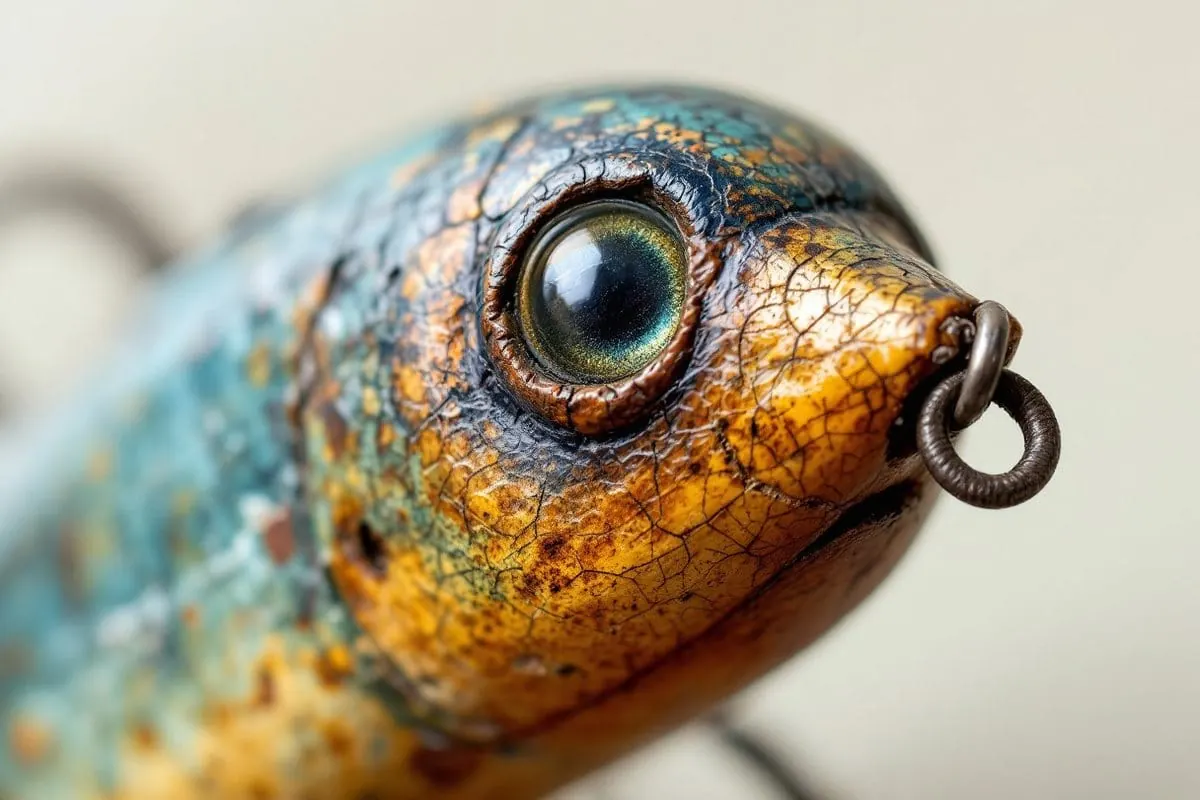
Once you know it's wood, the eyes help narrow the era. Think of them as a sequence rather than fixed dates, since each maker changed at its own pace. Our identification guide covers hardware and markings as well.
| Eye type | What it looks like | Where it falls |
|---|---|---|
| Glass | A clear or colored glass bead set into the wood | The early wooden years |
| Tack | A painted metal pin pushed into the head | Later wooden production |
| Painted | Eye painted directly on the body | Later wood and into plastic |
| None | No eye at all | Some early models and cheaper lines |
For a worked example, oldfishinglure.com's Lucky 13 history lays out one Heddon model's progression: early no-eye versions on cup rig hardware, then L-rig and toilet seat hardware, then flap rigs, surface rigs with tack eyes, and finally plastic with painted eyes.
Glass eyes are not a guarantee of age. Modern carvers and reproduction makers use them because they know collectors look for them. Treat glass eyes as one point in favor, then check that the hardware and wear tell the same story.
Where wooden lures turn up, and what to do first
Estate sales, barn cleanouts, garage sales and a relative's tackle box account for most finds. Whatever the source, the first hour matters more than the next month:
- Don't dump the box out. Lures stuck together by old plastic worms or rust come apart badly when pulled.
- Keep every box, paper and catalog, even torn ones.
- Separate wood from plastic, then set aside anything with glass eyes.
- Photograph the set as found before you start sorting. It helps later if a buyer asks about provenance.
- Price the best few individually before you offer anything as a lot.
Red flags
Wood is where the money is, so wood is where the problems are.
- Repaints. Paint over rust on the hardware, overspray in screw slots, paint inside the hook hangers, or a gloss that's too fresh for the lure's age.
- Reproductions. High-value models get copied. Wrong weight, crisp new hardware made to look old, and box printing that's slightly off are the usual tells.
- Married hardware. Props, lips or hooks swapped from another lure. Mismatched wear between body and metal is the sign.
- Clear coat. A shiny varnish layer over old paint. Someone tried to preserve it and cut the value doing it.
- Modern handmade lures sold as antique. Today's carvers make beautiful wooden lures with glass eyes. They're worth what the carver charges, not what an early factory original brings.
Hand-carved and folk art lures
Not every wooden lure came from a factory. Anglers carved their own for as long as there were bass to catch, and some of those homemade lures are now collected as folk art. They're the hardest wooden lures to value because there's no catalog, no model name and no run of sold listings to compare against.
What makes one desirable is craftsmanship and character: careful carving, imaginative paint, signs of real use, and a known maker or region when you can establish one. A crude whittled plug with a nail for a line tie is a curiosity. A finely carved and painted lure by a known local carver can sell well to the right buyer. If you have one, write down everything you know about where it came from before that information is lost. For folk art, the story is part of the value.
Taking care of them
Wood swells and splits when it gets wet and cracks when it dries too fast. Never soak a wooden lure, never put it in a dishwasher, and store it somewhere with stable temperature, out of direct sun. For the rest of the identification process, eyes, hardware and markings, read how to identify old fishing lures.
Some well-known models made in wood before switching to plastic have their own guides: the Jitterbug, the Zara Spook and the Crazy Crawler.