Work through the questions below in order. Most people only need the first two to know whether they have a collectible or a fishing lure.
Bomber in brief, with the source
The company history on USLures is the most complete public account. The key dates:
| Year | What happened |
|---|---|
| 1942 | C.S. "Turby" Turbeville and Ike Walker start Bomber as a small business in Gainesville, Texas |
| 1946 | The company is officially incorporated |
| 1947 | The Bomber lure is patented: a white cedar body with a large metal diving lip |
| 1971 | Bomber switches to plastic for all its lures |
| 1988 | PRADCO Outdoor Brands acquires Bomber |
The same source says the idea came from fishing Lake Murray, where the founders wanted a lure that would sink to real depth quickly and work through submerged brush without snagging. The buoyant cedar body let it float up and over snags when you paused, and the big lip drove it down when you reeled. The very first lips were cut from Prince Albert tobacco cans and the line ties were made by hand.
Question 1: is it actually a Bomber?
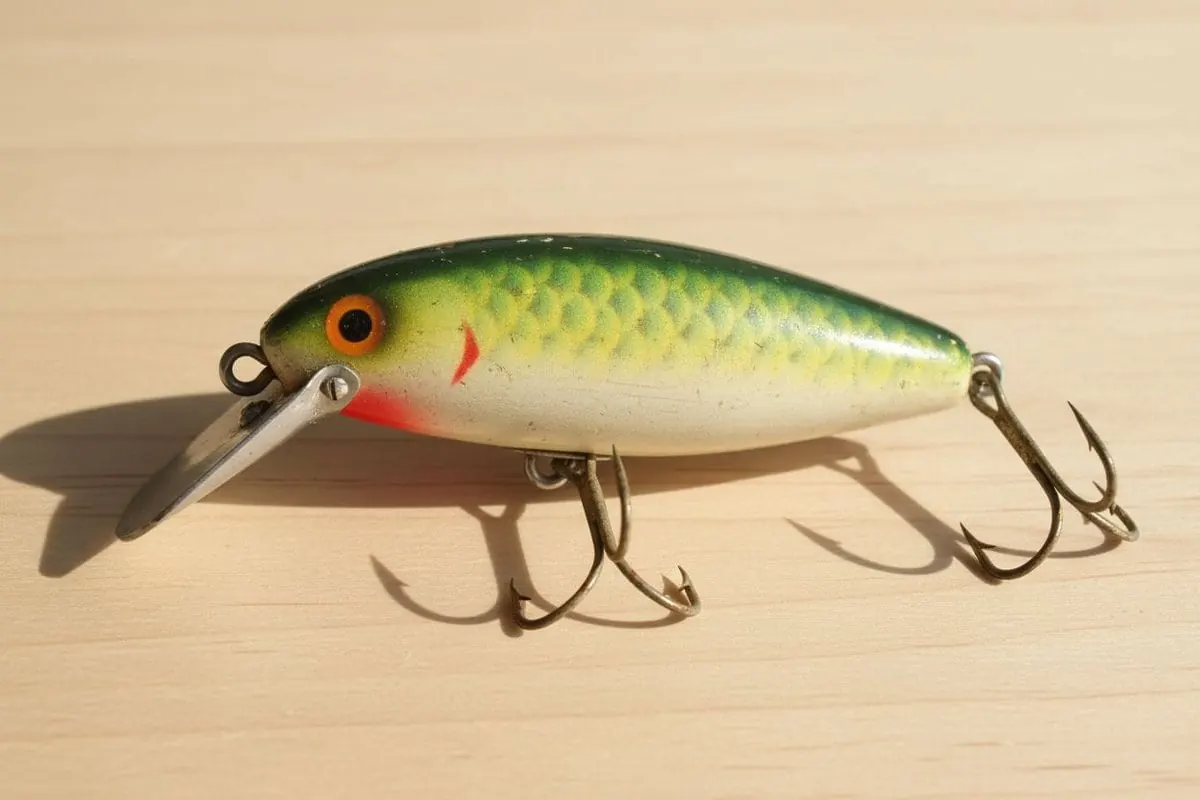
Look for these features on an early Bomber:
- A large metal diving lip under the head. That's the part that made the lure famous.
- A cigar-shaped body that tapers toward the tail.
- Bomber markings on the lip, the box or the card, if they've survived.
Plenty of companies made cigar-shaped crankbaits with metal lips, so shape alone doesn't make it a Bomber. Markings and the box are the strongest evidence. For lures that turn out to be something else, see fishing lure types explained to narrow down the family.
Question 2: wood or plastic?
This decides most of the value, and Bomber gives you a clean cutoff: all plastic from 1971, according to USLures. A wooden Bomber is older than that. Here's how to tell:
| Check | Wood | Plastic |
|---|---|---|
| Paint chip | Grain or pale fibrous wood underneath | Smooth plastic underneath |
| Seam | None | Fine line along the back and belly |
| Tap | Dull knock | Sharper click |
| Rattle | Usually silent | Many plastic crankbaits rattle |
| Paint wear | Chips at the nose, cracks along the grain | Scuffs, finish rubbed off evenly |
A rattle is a quick tell: solid wooden lures are usually silent, while many plastic crankbaits are hollow with rattle chambers. For more detail on proving wood without damaging the lure, see our antique wooden fishing lures guide.
Question 3: which model?
Bomber's catalog grew over the decades, and buyers search by model name, so get it right before you price or list. USLures catalogs Bomber lures by series and model, including the 200, 400 and 500 series and the Water Dog. Its 400 series page describes a wooden lure made from 1949 through 1970, while the 500 series it shows is a 1970s plastic rattling plug. Later Bomber names most anglers know, like the Model A and Long A, are plastic fishing lures rather than collectibles.
If you have a run of the same color in several sizes, keep them together; sets sell better than singles.
How to price a vintage Bomber
We don't publish price ranges. They go stale and hide the details that move a Bomber's price. Price from completed sales instead:
- Name it: series or model, wood or plastic, color, and whether you have the box or card.
- Search eBay for that description with the Sold Items filter on.
- Keep only sold examples in similar condition: lip straight or bent, paint bright or worn.
- Compare sold examples with and without packaging to see what yours adds.
- Use three to five matches, not one.
And these are the factors that move the number:
| Factor | Helps | Hurts |
|---|---|---|
| Body | Wood (before 1971) | Plastic, especially recent |
| Lip | Original, straight, firmly attached | Bent, loose or replaced |
| Paint | Original, bright | Repaint, heavy loss, cracked wood |
| Color | Short-run and uncommon colors | Common colors made in volume |
| Packaging | Original box or sealed card | None |
The broader pattern is explained on our old fishing lures worth money page. Bomber started later than Heddon or Creek Chub, so it's a brand people often collect because they fished it, and a big box of wooden Bombers can still add up.
When a Bomber is worth more than you'd expect
- Unopened packaging. A wooden Bomber still in its box, or a plastic one sealed on its card, sells to collectors who want the packaging as much as the lure.
- Matched sets. The same color across several sizes, or a full run of colors in one size, is worth more together than apart.
- Uncommon colors. Compare against sold listings with photos, not color names.
- Dealer displays and store stock. Counter displays, dealer cards and boxes of unsold stock from old tackle shops sell for more than their contents separately.
Condition notes specific to Bombers
A deep diver hits bottom and cover by design, so fished Bombers almost always show wear on the lip and nose. Collectors expect it on a used lure. What hurts more is cracked wood along the body, a lip that's bent out of line or loose in its screws, and splits around the screw holes, which are stress points on wooden examples. Look closely at the lip mount before you buy, and photograph it clearly before you sell.
When you can't name the model
Worn paint and a missing box are normal on old Bombers, and they make the model hard to name. Two references help. USLures keeps a catalog of Bomber lures with photos sorted by series, so you can match body shape, lip shape and paint pattern side by side. For anything that still doesn't match, the National Fishing Lure Collectors Club is where experienced collectors answer identification questions. Name it first, then price it; a wrong name sends you to the wrong sold listings.
Selling a box of Bombers
- Pull out every wooden one. That's where nearly all the value is.
- Group wooden ones by color. A matched set is easier to sell than scattered singles.
- Keep boxes and cards with the lures they came with.
- Sell plastic fishing models in lots to anglers. They want them to fish, and lots move fast.
- Don't clean beyond a dry brush, don't straighten lips, and don't swap hooks on the wooden ones.
Buying vintage Bombers
If you're collecting rather than selling, the main trap is paying for wood and getting plastic. Ask for a photo of a chip or worn spot that shows the body, remember the 1971 cutoff, and check that the lip matches the rest of the hardware. Treat listings that call every Bomber "rare" with suspicion; the honest sellers say when one is common.
Fishing an old Bomber
The plastic ones still catch bass. The big lip digs in on a steady retrieve and the lure wobbles hard; bumping it off rocks and stumps is the point, and the buoyant body helps it back away from snags when you pause. Wooden Bombers fish the same way, but a rocky bank chews up the paint fast, so save those for the shelf.
Bomber's PRADCO stablemates turn up in the same boxes: see our Rebel lures guide and Cotton Cordell guide. Found older lures from other makers in the same box? Run them through how to identify old fishing lures and check the vintage lure brands hub.