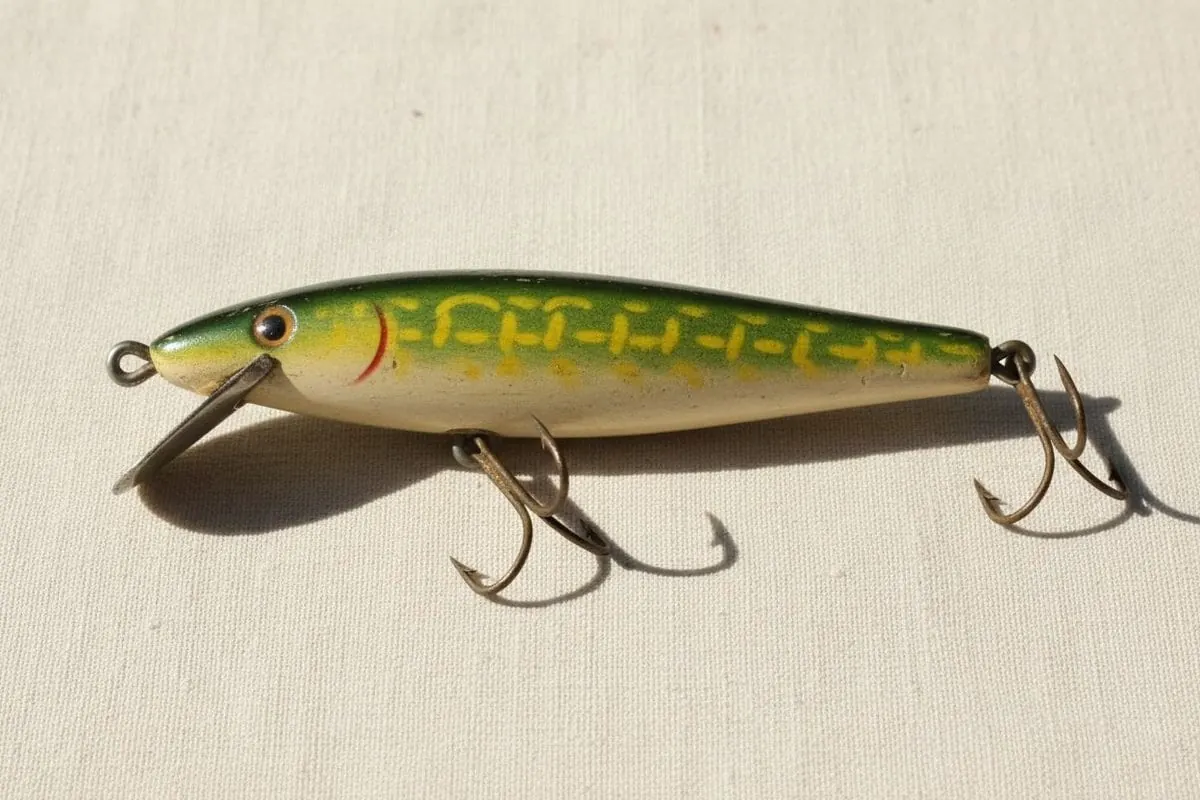
The Pikie is one of Creek Chub's signature lures. It was made for decades and sold in several versions, including jointed ones. Identify the variant first, because buyers search by variant and the prices differ.
The Garrett years in brief
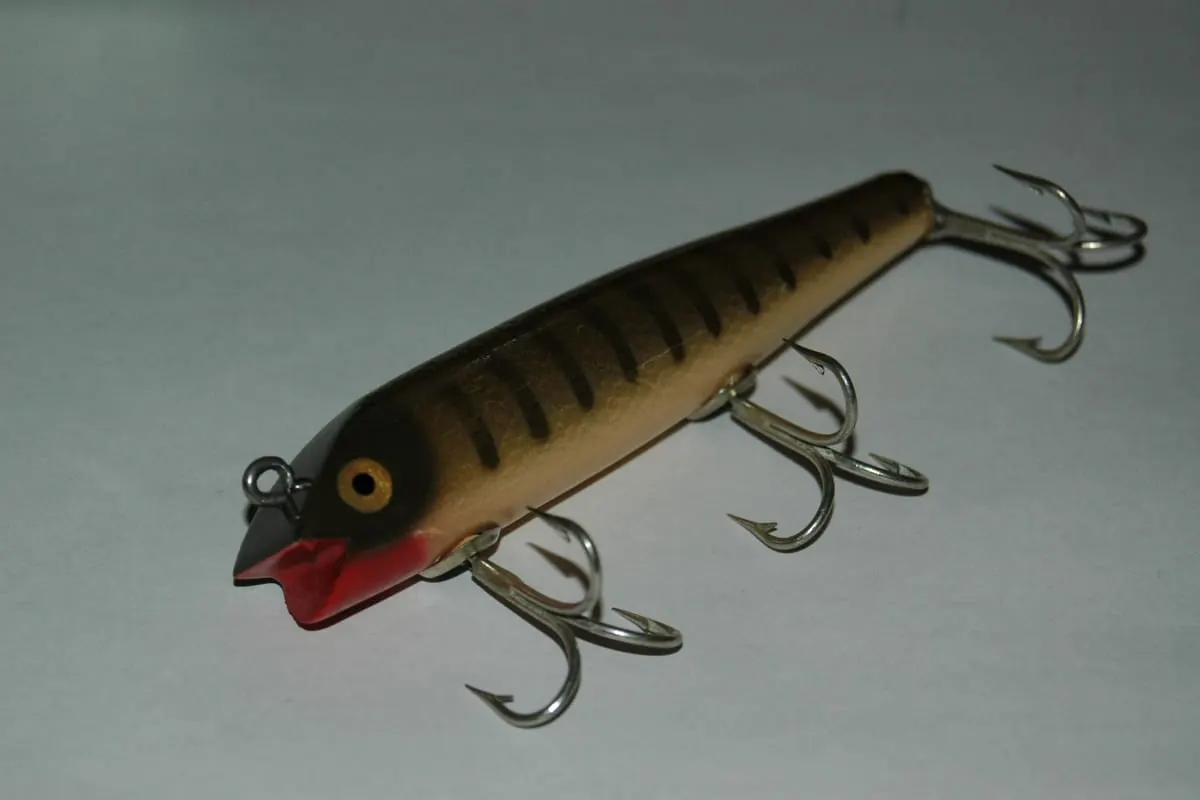
The facts below come from Wikipedia's Creek Chub Bait Company article. The company was founded in 1916 by Henry Dills, Carl Heinzerling and George Schulthess, and its home was Garrett, Indiana. A patent Dills filed in 1918 added a scale-like finish to the wooden body to imitate a real minnow; it was approved in December 1919. By 1936 the company reported sales in 48 foreign countries and held 32 patents. War Production Board orders curtailed lure making from 1942. Creek Chub began experimenting with plastic in the 1950s and 1960s, was bought by the Lazy Ike Corp. in 1978, and the Garrett factory had closed by 1979.
The company's most famous catch: on June 2, 1932, George Perry landed a 22 pound 4 ounce largemouth at Montgomery Lake, Georgia, on his only lure, a Creek Chub Fintail Shiner in Silver Shiner finish, according to the Georgia Historical Society. For collectors, the practical split is simple: wood from the Garrett years is the collectible core, plastic is mostly tackle.
The Pikie variants
| Variant | How to recognize it |
|---|---|
| Pikie Minnow | One-piece body, metal diving lip under the chin |
| Jointed Pikie | Body in two hinged sections |
| Triple Jointed Pikie | Body in three sections |
| Larger and specialty Pikies | Collector listings include Husky and Snook Pikies |
If the body is cut and hinged, you have a jointed version, whatever the size. Count the sections. Big, heavy Pikies draw musky tackle collectors, a separate group from bass lure collectors. Because buyers search by variant, get the name right before you price or list it.
Dating a Pikie
Creek Chub made the Pikie in Garrett, Indiana, for decades, so the same shape covers a long span. Three details narrow it down.
Eyes
Glass eyes are the earlier style on Creek Chub's wooden lures and painted eyes the later one, with the change happening at different times for different models. Glass eyes on a Pikie are the first thing a collector checks.
Body material
Wood through the classic years; plastic only from the 1950s and 1960s experiments on. Grain under a chip means wood; a thin seam running along the body means plastic. If you're not sure, our wooden lure guide has five tests that don't damage the lure.
The lip
Read any marking on the diving lip under a strong light. A Creek Chub marking confirms the maker. An unmarked lip on a Pikie shape, with no box to back it up, more often means a copy from another company, and there were many.
Putting the three together
No single detail dates a Pikie on its own. Glass eyes, a wooden body and a Creek Chub marked lip together put you in the early decades. Painted eyes on wood with the same marked lip move you later. A plastic body ends the question. When the clues disagree, for example glass eyes on a lure with modern hooks and fresh-looking paint, suspect a repaint or swapped parts before you assume an early date.
Colors
Creek Chub's best-known contribution to lure painting was the realistic scale finish it patented in 1919. On a Pikie, color sorts roughly like this:
- Common: the standard catalog finishes made in volume. Found in every old tackle box.
- Less common: colors that were only cataloged for a few years.
- Rare: special-order and short-run colors. These are the Pikies collectors hunt for.
Crisp, sharp scale detail suggests a lure that was fished lightly or not at all. Scales worn smooth on the belly and sides mean years of use, which is fine for a fishing lure and a discount for a collector.
Real Pikie or a copy?
Popular lures attracted copies from other companies, and some look close enough to fool a quick glance. Check these before you list one as a Creek Chub:
| Detail | Creek Chub Pikie | Typical copy |
|---|---|---|
| Lip | Creek Chub marking | Plain or marked by another maker |
| Scale finish | Even, crisp scale pattern | Blotchy, uneven or printed |
| Hardware | Consistent with the era of the eyes and body | Cheap screw eyes, mixed styles |
| Body shape | Pointed nose, smooth taper to the tail | Blunter, thicker or lumpier |
| Box | Creek Chub box with model and color on the label | Generic or no box |
A copy isn't worthless. Some competitors' lures are collectible in their own right. They just shouldn't be priced or listed as Creek Chub, and buyers will notice if they are.
Reading a Creek Chub box
If the Pikie came with a box, the box can be worth as much as the lure. A label with the model and color lets a buyer confirm that lure and box belong together. Look for:
- A label that matches. The model and color on the box should match the lure inside. A mismatched box is still worth something, but less.
- All the pieces. Lids get lost. A complete box beats a bottom alone.
- Inserts and papers. Any paper insert or catalog that came with the lure adds value. Keep it with the box.
- Condition. Crushed corners and fading are normal. Tape, writing and water damage lower the value, but a rough box is still much better than none.
How to price a Pikie
We don't publish price ranges. The Pikie was made in so many variants, colors and conditions that a range would be meaningless. Price from completed sales instead:
- Name it: variant, wood or plastic, glass or painted eyes, color.
- Search eBay for that description with the Sold Items filter on.
- Keep only sold examples in similar condition, with matching eyes and body material.
- Compare sold examples with and without a box to see what yours adds.
- Use three to five matches. For rare colors or big musky versions, ask collectors too; sales are thin and one result can mislead.
Our Creek Chub guide covers the brand's other models, and old fishing lures worth money explains why boxes and colors move prices across all makers.
Fishing a Pikie
A modern Pikie is still a good crankbait. Cast it, reel at a steady medium pace, and the lip pulls it down and gives it a tight wobble. The Jointed Pikie swims wider and slower, which works better in cold water or for pike and musky that follow before they bite. Rod tip down makes it run deeper, rod tip up keeps it shallow. Bump it off wood and rocks: deflections trigger strikes. Leave the wooden ones at home; rocks are exactly what ruins their paint.
Five mistakes with Pikies
- Calling every crankbait with a metal lip a Pikie. Copies were everywhere. No Creek Chub marking or box, no Creek Chub price.
- Selling a box of them as one lot. One glass-eye wooden Pikie in a scarce color can be the most valuable lure in the box.
- Straightening a bent lip. It can crack the wood around the screws. Leave it.
- Swapping the hooks. Rusty original hooks are worth more to a collector than shiny new ones.
- Separating box and lure. Sell them together, and make sure the box matches the variant and color.
For the general method that works on any brand, from eyes to hardware to boxes, see how to identify old fishing lures. If you're also sorting Heddon lures from the same box, start with the Lucky 13 checklist.