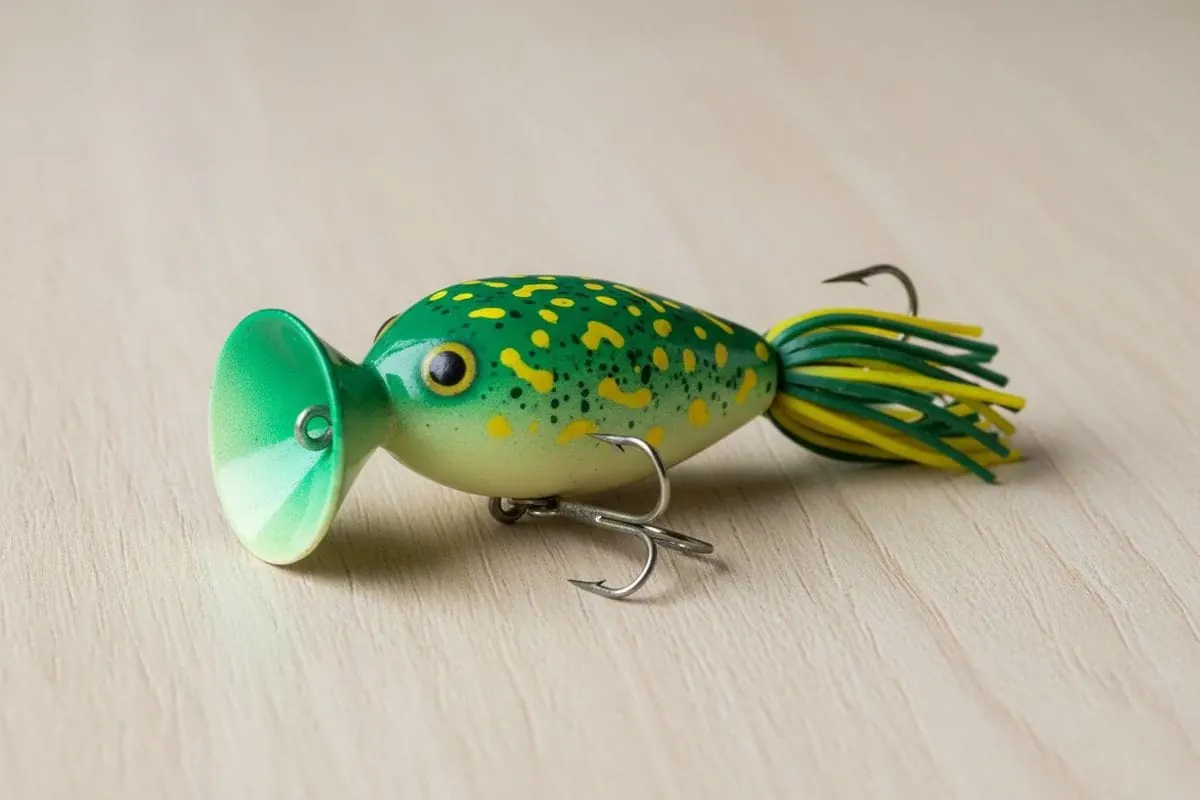
If you found a cupped-face topwater with a rubber skirt in an old tackle box, there's a good chance it's an Arbogast. This guide covers how to confirm that, how the Hula Popper fits among Arbogast's other skirted lures, how to look after a rubber skirt that's gone sticky, and how to put a price on it without guessing.
The company behind it
The company history on USLures is the clearest public account. Fred Arbogast worked at Goodyear Tire and Rubber in Akron, Ohio, and carved lures for casting competitions and his own fishing. His Tin Liz, introduced commercially around 1930 and made in at least six variations, did well enough that he left his job to make lures full time. The company became known for bass lures, especially surface lures built around sound and movement.
Fred Arbogast died in 1947 and the company kept adding models. The Akron factory stayed open until 1997, after which the company was sold to PRADCO, which still makes several of the established models, the Hula Popper among them.
What makes it a Hula Popper
USLures describes the two features that define it. Check both:
- A deep concave nose. The face is hollowed out like a cup, and a twitch of the rod makes it throw water and splash.
- The Hula Skirt. A rubber skirt at the tail that pulses and opens when the lure pauses. This skirt is a defining feature across many Arbogast designs.
A cupped popper without a skirt can be a fine lure, but it isn't a Hula Popper. A skirted lure with a different front end is probably one of Arbogast's other skirted models, covered next.
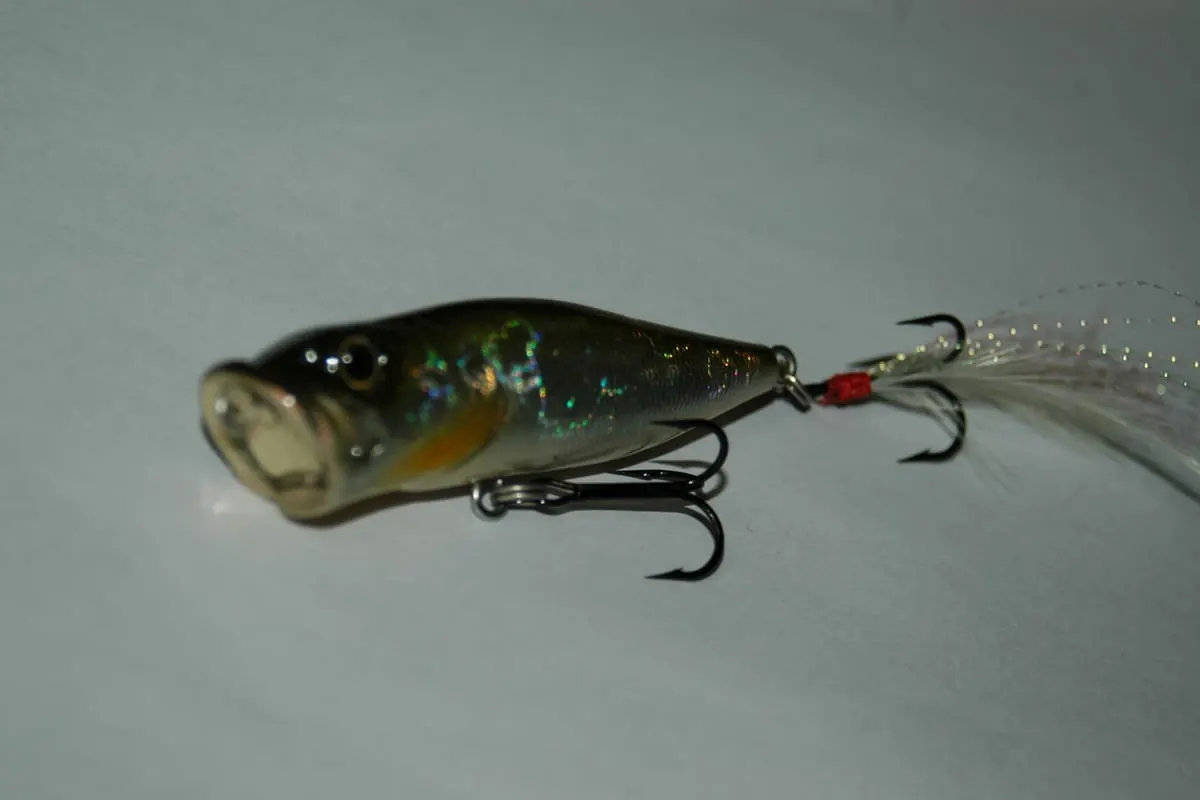
The Arbogast family, side by side
Arbogast used the skirt on several lures, and they get mixed up in listings. The descriptions below follow USLures:
| Lure | Front end | Skirt | Where it fishes |
|---|---|---|---|
| Hula Popper | Deep concave nose | Yes | Surface, splash and pause |
| Jitterbug | Wide metal lip across the face | No | Surface, steady gurgling retrieve |
| Hawaiian Wiggler | Front spinner blade, weedless build | Yes | Heavy vegetation |
| Hula Dancer | Front lip for vibration | Yes | Below the surface |
| Sputterbug | Large front propeller | Yes | Surface, noisy trail |
If yours has a wide metal lip and no skirt, read our Jitterbug guide instead. Later Arbogast names you may also see in old boxes include the Arbo-Gaster, Bug-Eye, Hustler, Mud Bug and Pug Nose.
Checking an old one
Because the Hula Popper has stayed in production, most of the ones you find are plastic and common. Work through these points to see whether yours is anything more:
- Markings. Look for the Arbogast name on the body, hardware or packaging. No markings at all, plus cheap hardware, points to a lookalike.
- The skirt. Is it the original rubber skirt, and is it intact? Skirts dry out, go sticky or get replaced over the years. A modern silicone skirt on an old body is a replacement.
- Hardware and hooks. Compare against a new Hula Popper. Different hook hangers or older-style hooks suggest an earlier lure. Bright new hooks on split rings suggest a replacement or recent production.
- Paint. Original paint with honest wear beats a bright finish that looks too new for the rest of the lure.
- Box or card. Packaging style often dates a lure better than the lure itself, so keep it with the lure.
The broader checks that work on any maker are in our guide to identifying old fishing lures.
Looking after the rubber skirt
The skirt is the part that ages worst. Old rubber can go tacky, stick together or crumble, and on a collectible lure the skirt's condition matters. The collector site Lure Lore publishes a tip from collector John Walker for cleaning and restoring rubber baits:
- Wipe on a lanolin-based hand cleaner such as GO-JO or M-30 and work it into the rubber.
- Let it sit for 30 minutes to an hour.
- Rinse with warm water, then cold water, and pat dry.
Try it on a small section first. Keep the cleaner off painted surfaces where you can, and store skirted lures where the skirt doesn't press against other lures or plastic trays. The same Lure Lore page describes tackle box trays cracking and melting where plastic and rubber worms touched them, which is a good reason to keep old soft plastics away from your collection. More on that in our cleaning notes.
How to price one
We don't publish price ranges. The Hula Popper has been made for so long that the spread between a common recent one and a scarce early one is huge, and only completed sales capture it.
| Factor | Helps | Hurts |
|---|---|---|
| Skirt | Original rubber, intact, still flexible | Missing, melted or replaced |
| Hardware | Older style, original to the lure | Modern replacement hooks and rings |
| Paint | Original, bright, light wear | Repaint, heavy loss |
| Color | Uncommon factory colors | Common colors made in volume |
| Packaging | Original box or card that matches | None |
- Search eBay for "Arbogast Hula Popper" plus the color, with the Sold Items filter on.
- Keep only sold examples with a similar skirt and paint condition.
- Compare examples with and without packaging.
- Use three to five matches, not one.
For why boxes and colors matter so much across all makers, see old fishing lures worth money.
How to fish it
The Hula Popper rewards patience. Cast it near cover, then leave it until the rings fade. Give the rod tip a short, sharp twitch: the cupped face grabs water and throws a splash. Then stop. While it sits, the skirt settles and flares, and that slow movement is what makes a fish commit. Vary the rhythm: a single pop and a long pause in calm water, a few pops in a row when fish are active.
Keep the line slightly slack between pops so the lure sits naturally, and wait until you feel the fish before setting the hook. Topwater strikes are easy to miss by reacting to the splash. If you have an older one with an original skirt, fish a new one instead; the skirt is the first thing to go.
Common listing mistakes
- Calling every skirted Arbogast a Hula Popper. A front spinner means Hawaiian Wiggler; a big front propeller means Sputterbug.
- Leaving out the skirt condition. It's the first question a buyer asks, so say whether it's original, flexible, sticky or replaced.
- Cleaning the skirt with solvents. Alcohol and thinners can ruin old rubber; use the gentler method above or leave it.
Before you sell a box of Arbogasts
- Sort by model using the family table above. Buyers search by model name.
- Pull out anything with an original, intact skirt and its box.
- Don't trim, replace or glue skirts. A worn original beats a fresh replacement for a collector.
- Photograph the face, the skirt spread out, the belly hardware and any markings.
For the other topwater families you might find in the same box, see fishing lure types explained, and for Heddon's answer to the Jitterbug, the Crazy Crawler.